
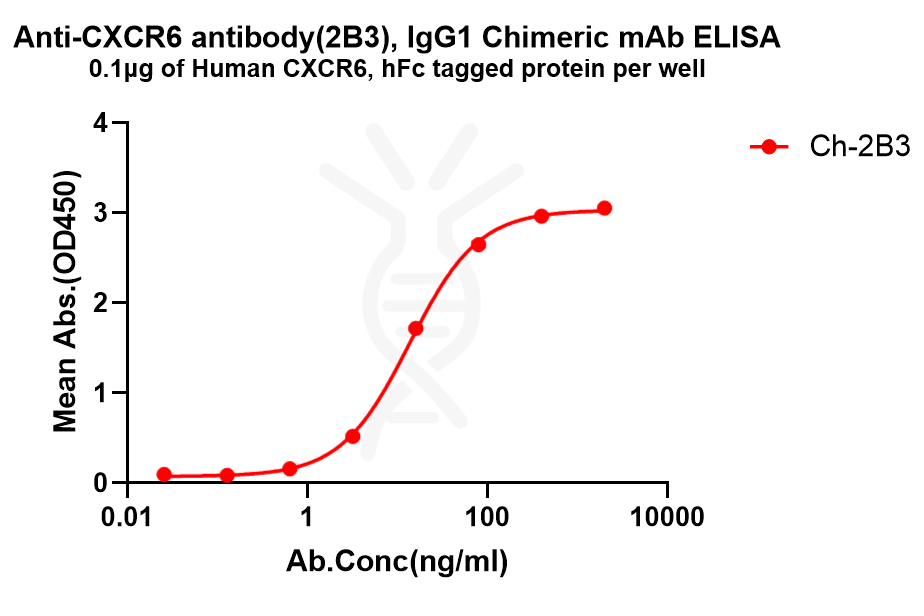
| Clone ID | 2B3 |
|---|---|
| Target | |
| Synonyms | BONZO; CD186; CDw186; STRL33; TYMSTR |
| Host Species | Rabbit |
| Description | Anti-CXCR6 antibody(2B3), IgG1 Chimeric mAb |
| Delivery | In Stock |
| Uniprot ID | O00574 |
| IgG type | Rabbit/Human Fc chimeric IgG1 |
| Clonality | Monoclonal |
| Reactivity | Human |
| Applications | ELISA |
| Recommended Dilutions | ELISA 1/5000-10000 |
| Purification | Purified from cell culture supernatant by affinity chromatography |
| Formulation & Reconstitution | Powder |
| Storage & Shipping | Store at -20°C to -80°C for 12 months in lyophilized form. After reconstitution, if not intended for use within a month, aliquot and store at -80°C (Avoid repeated freezing and thawing). |
| Background | The protein encoded by this gene is a G protein-coupled receptor with seven transmembrane domains that belongs to the CXC chemokine receptor family. This family also includes CXCR1, CXCR2, CXCR3, CXCR4, CXCR5, and CXCR7. This gene, which maps to the chemokine receptor gene cluster, is expressed in several T lymphocyte subsets and bone marrow stromal cells. The encoded protein and its exclusive ligand, chemokine ligand 16 (CCL16), are part of a signalling pathway that regulates T lymphocyte migration to various peripheral tissues (the liver, spleen red pulp, intestine, lungs, and skin) and promotes cell-cell interaction with dendritic cells and fibroblastic reticular cells. CXCR6/CCL16 also controls the localization of resident memory T lymphocytes to different compartments of the lung and maintains airway resident memory T lymphocytes, which are an important first line of defense against respiratory pathogens. The encoded protein serves as an entry coreceptor used by HIV-1 and SIV to enter target cells, in conjunction with CD4. [provided by RefSeq, Aug 2020] |
| Usage | Research use only |
| Conjugate | Unconjugated |


服務(wù)熱線
400-006-0995
18062749453